
Traveling with golf clubs? Don't take this unnecessary risk
At the start of a media trip only a few years into my career as a traveling golf journalist, I was hanging out with a few veteran golf writers by one of the baggage claim carousels inside Missouri’s Springfield-Branson National Airport, waiting for everyone’s clubs to arrive. When details of my sticks came up in conversation, I opened my travel bag to pull out an iron. That’s when one of the more experienced travel writers dropped some knowledge on me.
“You travel with your clubs like that?” he asked, clearly surprised.
I had no idea what he was getting at. I had headcovers on the driver, fairway wood and hybrids, and the bag was securely tucked inside the travel bag. All seemed fine to me.
“You should protect them more,” he said.
As I learned that afternoon, this particular writer always removes the heads of his driver and fairway woods, tucking them into the side pocket of his golf bag whenever he travels. As he told me, it’s more common than you might think for clubs to be broken, given how baggage handlers haphazardly toss golf travel bags around. More specifically, those bags are routinely thrown head-on into barricades, the inner walls of baggage transport vehicles, and other hard surfaces. At that angle of impact, the force can easily cause lightweight graphite shafts to bend awkwardly and snap. Influencer Erik Anders Lang experienced this several years ago, and he documented it in a vlog that he posted back in 2021.
The thought of removing clubheads each time I pack my golf bag for a trip didn’t sit well with me then, and it still doesn’t today. Even though my driver, woods and hybrids are all adjustable, I never tinker with the settings. Once I’ve been expertly fit with new equipment, I leave things alone — I’d rather adjust the mechanics of my swing than the loft and lie angles of my club. Removing a clubhead entirely and then reattaching it after a flight fills me with acute uneasiness. I fear I wouldn’t be able to return the club to the exact specs that were originally calibrated for my swing.
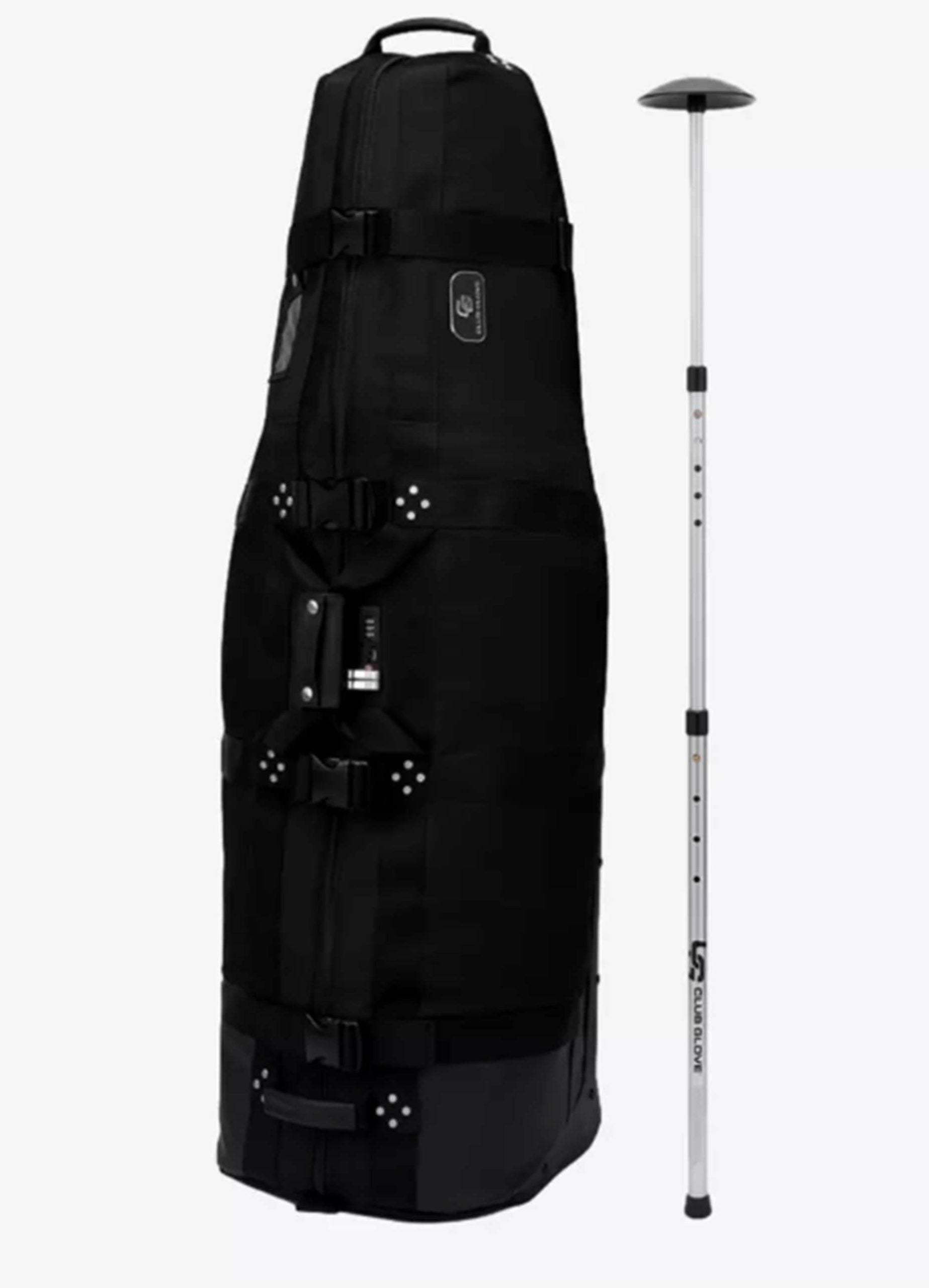
Train Reaction System (TRS) Pro Traveler 2025 Golf Travel Bag
Fortunately, there’s another solution for club protection. Products such as Club Glove’s Stiff Arm, BagBoy’s Backbone, the Club Shield by Tour Trek, and Caddy Daddy’s North Pole Club Travel Protector all provide a necessary buffer between your clubs and the top end of the travel bag. These extendable devices effectively act as a shock absorber, taking the brunt of any head-on impacts, leaving your clubs unscathed.
I’ve employed their use for more than a decade and — knock on wood — I have never suffered any club damage. Years ago, however, I did open my travel bag to find that the Backbone inside had broken. But you could argue the device did its job — if the transport of my bag broke the Backbone, you can imagine what it would’ve done to my driver. And I’d much rather spend $40 to replace a travel accessory than $500 for a new club.
So, if you’re not taking measures to ensure your clubs are well guarded against negligent baggage handlers, be it through the aforementioned tactics or using a hardcase travel bag, you’re taking on a lot of risk each time you travel. And as you know, minimizing risk is the key to good scores on the course. We recommend it here too.
The post Traveling with golf clubs? Don’t take this unnecessary risk appeared first on Golf.