
4 Smart Ways Mopeds Fit Into Modern Car Culture
 Mopeds beat modern cars for automotive enthusiasts because they provide practical daily driver relief, enhance short-distance cruising, reduce show season fuel costs, and add a unique layer of mechanical identity to your lifestyle.
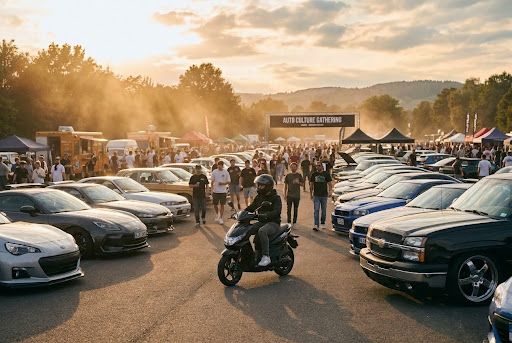
Look around a packed car meet lot at golden hour, past the slammed trucks and mirror-polished muscle builds, and you will likely spot a few riders weaving through the crowd on two wheels.
These compact machines are emerging as practical extensions of evolving car culture trends rather than competing identities.
As the sun drops and the lot lights flicker on, LED underglow bleeds across the wet asphalt. The familiar low rumble of heavy engines and the sharper bark of cold starts cut through the ambient crowd noise.
In this hyper-curated space, a rider casually navigating the rows on a simple moped does not look out of place or apologetic. It draws second glances that register as recognition, not confusion.
Mopeds are not here to challenge a carefully planned project build or replace an enthusiast’s hard-earned identity.
Instead, they exist to keep the lifestyle moving when the primary machine simply cannot. They offer a refreshing change of pace for builders who want to stay engaged.
1. Your Build Deserves a Break
Every weekend warrior knows the quiet frustration of a vehicle up on jack stands, waiting on a specialized part that shipped two days late. When show day is six weeks out, timelines become tight, but the realities of daily life do not pause for your project.
The grocery store, the commute, and the inevitable errand runs do not care about your suspension adjustment schedule.
In fact, passenger vehicles handle the vast majority of our travel, making constant motion a daily necessity.
There is a tangible cost to daily driving a show car, and it is measured in more than just dollars. It is the anxiety of accumulating unnecessary miles on a machine built for the stage.
It is the stress of navigating tight parking lots, the perpetual fear of a careless door ding, and the compounding damages that become impossible to ignore.
While many turn to older beaters or aging pickup trucks as daily driver alternatives, those options still require their own maintenance, insurance, and parking footprint.
This is exactly where two-wheeled transport steps in as a highly practical answer that does not force an enthusiast to step away from their mechanical roots. It is a purpose-built tool designed for this precise gap in the calendar.
Lightweight, immune to the usual parking anxieties, and requiring incredibly minimal maintenance, a scooter slips effortlessly into the downtime of a major build.
Navigating a build’s downtime requires a practical pivot. Rather than risking another unreliable project car, many enthusiasts now opt for versatile moped scooters.
Sourcing these through specialized teams like NTX Power Sports ensures a road-ready solution that doesn’t eat into the primary build’s budget. It is a strategic move that provides a dependable daily ride, allowing the show car to stay on stands until it’s truly ready for the stage.
Many models are fully certified for street use, meaning the documentation matches the utility.
Layer in the natural benefits of accessible parts, optional professional assembly, and basic warranties, and the moped becomes less of an alternative and more of a strategic necessity. It is the simplest way to keep life moving while the show car rests.
| Warning/Important: Don’t let your daily commute degrade your project’s value. Every mile spent in stop-and-go traffic is wear and tear that subtracts from your build’s longevity and shows-ready condition. Play it smart. |
2. Short Hops Between Meets Hit Different
Alt: Night street race with vibrant lights and vehicles
The energy of a local car meet rarely stays confined to a single parking lot. It thrives in the late-night gas station stops where half the attendees inevitably congregate, or during that quick, spontaneous roll between nearby industrial parks.
Neighborhood cruises that begin with two cars frequently end with eight, building momentum entirely through proximity and shared enthusiasm.
When you navigate these short distances on a moped, the quality of the experience changes entirely. The insulation of a sealed modern car cabin is gone. On two wheels, you are not just observing the environment; you are inside it.
The shift in evening temperature, the sharp scent of exhaust, and the echoing sound of engines bouncing off commercial buildings become immediate and present.
Spontaneity is a deeply held value in the automotive scene, and nothing embodies that quite like a moped.
There is no trailer to hitch, no elaborate prep ritual, and no complex parking logistics to negotiate. It just requires a twist of the throttle, and you are moving with the group. Show season cruising thrives on this kind of friction-free mobility.
Visually, the contrast actually works entirely in the rider’s favor. Pulling into a meet on a clean, well-maintained moped right alongside a trailered, high-horsepower build creates a dynamic dimension that monolithic car culture sometimes flattens out.
Today, convoy roll-ins that seamlessly blend two-wheeled transport with four have become a recurring, celebrated element of show season cruising.
A moped does not separate you from the pack; it simply adds a highly visible layer to the shared experience.
3. Save Fuel for What Actually Matters
A full show season is not a weekend sprint; it is an endurance marathon that can easily stretch across several months and require dozens of expensive fill-ups.
The reality of the automotive lifestyle is that entry fees, premium fuel, specialized tires, and relentless maintenance costs do not hit the pause button.
Recent data shows that fuel economy estimates are improving across modern vehicle fleets. However, aggressive driving styles and modified engines often mean show cars burn through fuel much faster than factory models.
Owning a moped is not about making a begrudging budget concession. Instead, it functions as deliberate, strategic resource management. Federal authorities are pushing for stronger fuel efficiency standards in the near future to combat rising vehicle costs.
By allowing a highly efficient machine to absorb the short local errands, the primary vehicle’s premium fuel is actively preserved for the moments that truly demand it.
The real-world scenario is simple: skipping the gas pump three or four times a week during the long stretch between events adds up to a surprisingly substantial amount of capital.
It reflects an underlying cultural truth within the community to ride more, but spend less, where it does not impact the experience. That preserved capital translates directly back into the hobby.
Every single dollar that is not burned on unremarkable, stop-and-go commuting miles is a dollar freed up for the next meaningful modification.
It is the cash needed for that premium entry fee, the custom fabrication work you have been putting off, or the rare part currently sitting in an online cart.
Enthusiasts who treat their hobby like a long-term investment recognize this logic immediately. It is about allocating your resources smartly so the builds and events that are worth doing receive the funding they deserve.
| Pro Tip: Calculate your monthly fuel savings by switching to a moped for local errands. Redirect those “lost” gas dollars into a dedicated performance part fund to accelerate your next build phase. |
4. A Moped Elevates Your Automotive Identity
The enthusiasts who hold the deepest respect in the scene are rarely the people with only one vehicle and a single, rigid narrative.
True automotive passion is inherently multi-dimensional. The most interesting builders are always tinkering, always adding to their garage, and always exploring mechanical directions that manage to surprise their peers.
A moped functions as a statement piece and a natural conversation starter in the same way a perfectly chosen aftermarket modification does.
It signals to the community that the owner values the fundamental mechanics of the ride itself, rather than just the perceived social status of the badge on the hood. This authenticity is impossible to fake.
If you look closely at current car culture trends, you will notice mopeds appearing with increasing consistency.
They are spotted tucked behind vendor tents at major events, featured naturally in automotive lifestyle video content, and ridden by the same fabricators who spend their days restoring vintage classics.
This growing overlap is not accidental; it is a shared appreciation for simple, honest machinery.
Furthermore, the deep-seated customization instinct naturally carries over. The same creative impulse that leads an enthusiast to obsess over a specific wheel finish extends directly to personalizing a moped.
The aesthetic language of clean lines, curated colors, and mechanical simplicity is entirely shared. As daily driver alternatives continue to evolve, they are becoming a broader reflection of how enthusiasts define their identity.
| Key Insight: Real enthusiasts value the soul of the machine over the price of the badge. A moped proves you appreciate mechanical simplicity and tactical utility, marking you as a versatile builder. |
The Road Forward
When you look back on a season, the best automotive stories have never been exclusively about the show car sitting stationary under the convention center lights.
The memories that last usually live in the spaces between the major weekend events.
They are found in the late-night cruise that accidentally turned into a three-hour journey, the casual gas station conversation that forged a lasting friendship, and the spontaneous ride that absolutely nobody planned but everyone vividly remembers.
Mopeds occupy that vibrant, transitional space fully and naturally. They do not compete with your primary build for attention; they complete the active automotive lifestyle that surrounds it.
That rider weaving through the packed lot at the very beginning of the night was never an outsider looking in. They were exactly where they belonged, deeply in the scene and contributing their own distinct energy to the evening.
The lifestyle does not stop when you park the project car for the night.
Embracing nimble, two-wheeled transportation opens up an entirely new dimension of show season cruising. It confirms that car culture is not strictly about the specific machine you drive.
Ultimately, it is about how you choose to stay in continuous motion.
The post 4 Smart Ways Mopeds Fit Into Modern Car Culture appeared first on Gauge Magazine.