
Leadership Spotlight: Jason Sheasby
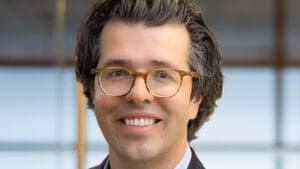
We talk to Jason Sheasby a partner at Irell & Manella LLP about what makes him a great leader.
Please introduce your work and describe the role you play in shaping its direction.
I am a partner at Irell & Manella LLP. I focus on high-stakes trial work, mostly in intellectual property and complex commercial disputes. I also help shape direction through how we choose cases, build trial teams, and prepare matters. My role is not just to argue cases. It is to define how we approach them—what we prioritize, how we simplify, and how we execute under pressure.
How do you build teams and systems to execute that work?
I build small, focused teams. Each person has a defined role tied to a specific part of the case—facts, law, technical narrative, or witness prep. I avoid duplication. I also avoid overstaffing.
We keep core work in-house. That includes strategy, key writing, and trial presentation. We bring in external experts when needed, especially in technical areas such as memory systems or data storage. The system is simple: clarity of ownership, short feedback loops, and daily alignment as we near trial.
From your perspective, how do you stand out in a competitive field?
We reduce complexity faster than others. Most cases involve large volumes of technical detail. The difference is not who has more information. It is about organizing it into a structure that a decision-maker can follow.
In recent trials involving companies like Netlist and StreamScale, the outcome depended on how clearly the issues were framed. That is the core differentiator.
Who do you primarily serve, and how has that focus evolved?
I serve companies dealing with complex technology disputes. That includes areas like computer memory, data systems, and device technology.
The focus has not changed much. What has changed is the scale and speed. Cases now involve more data, more technical layers, and shorter timelines.
What problems do clients bring to you, and how do you decide what to take on?
Clients come with high-risk disputes. Often involving patents, contracts, or both. The common feature is complexity tied to real financial exposure.
I take cases where the core issue is clear. If it cannot be explained in a structured way, it is difficult to try effectively.
How do you stay ahead when information moves quickly?
I do not try to track everything. I focus on patterns.
I read primary material—cases, technical documents, transcripts. I avoid relying only on summaries. The goal is to understand how decisions are actually made, not just how they are described.
What does long-term trust with clients look like?
It is consistency. Clients return when outcomes align with expectations and communication is direct.
Trust builds when there are no surprises. That means being clear about risks, timing, and constraints from the start.
How do you define success for clients, and how do you deliver it?
Success is achieving a defined outcome under known constraints. That could be a verdict, a settlement position, or a strategic advantage.
We define that early. Then we align all work to that outcome. Every argument, every witness, every exhibit serves that goal.
What responsibility do you have after a matter is complete?
We stay involved where needed. That may include follow-on proceedings, enforcement, or related disputes.
There is no formal system beyond staying available and maintaining continuity of knowledge.
How do you approach pricing and value alignment?
Pricing reflects complexity, risk, and time commitment. Trials are resource-intensive.
Value alignment comes from setting expectations early. Clients understand what is required and why.
How do you think about fairness in pricing?
Fair value means the work matches the cost. It is not about being the lowest cost. It is about being predictable and aligned with the outcome being pursued.
Have you said no to opportunities that looked attractive? Why?
Yes. If a case lacks a clear path to a coherent argument, I decline.
The principle is simple: if the decision-maker cannot understand the issue, the outcome is unpredictable.
What challenges have shaped how you lead?
One challenge is managing large volumes of information without losing focus.
Early in my career, I assumed shared understanding. That led to gaps. Now I build everything from first principles. Nothing is assumed.
How do you create space for innovation while staying disciplined?
Innovation comes from constraint.
We limit the number of arguments. We limit the number of themes. That forces better thinking. New ideas emerge within that structure.
What role does culture play in performance?
Culture defines how people work under pressure.
I model direct communication, preparation, and accountability. No unnecessary complexity. No unclear ownership.
Looking ahead, what impact do you want your work to have?
I want to continue improving how complex issues are understood and decided.
That applies to litigation, but also to areas like biotechnology through TORL Biotherapeutics and institutional work with Pomona College.
How has your leadership approach evolved?
It has become more focused on clarity and less on volume.
Earlier, I valued completeness. Now I value precision. Fewer points, better developed.
Which emerging shifts are most important to you?
Artificial intelligence.
Not as a replacement for judgment, but as a filtering tool. It helps manage large datasets. The human role remains in interpretation and decision-making.
What advice would you give to emerging leaders?
Focus on understanding, not output.
One lesson that changed my approach: if you cannot explain something simply, you do not understand it well enough to act on it.
Read more:
Leadership Spotlight: Jason Sheasby