Battle for Hungary: How the EU plans to defeat Viktor Orban
Brussels is deploying all of its influence and censorship machinery ahead of the Hungarian election
Three weeks out from the most consequential European election of the year, the EU has aimed every weapon in its arsenal at Hungary, as Brussels prepares for its best shot yet at taking out Prime Minister Viktor Orban.
Orban’s animosity toward the EU establishment runs deep. For more than a decade, the Hungarian prime minister has often been the bloc’s sole dissident: railing against its open-door migration policies, embrace of LGBT ideology, and “suicidal” plan to welcome Ukraine into the union. Orban has secured carve-outs from the EU’s anti-Russian sanctions that enabled Hungary to continue purchasing Russian oil, and is currently vetoing a €90 billion loan package for Kiev.
Read moreEU threatens Hungary over Ukraine loan – Politico
The EU has responded by withholding funds equal to 3.5% of Hungary’s GDP over his banning of LGBT propaganda and refusal to accept non-European migrants. With the future of its Ukraine project now on the line, Brussels has pinned its hopes on Peter Magyar and his Tisza party, which promises to overturn Orban’s domestic reforms and Budapest’s opposition to the EU’s designs in Ukraine and beyond.
After the European Council failed to find a workaround to Orban’s veto at a March 19 meeting, the EU’s chief diplomat, Kaja Kallas, hinted that work was underway on a “Plan B.” Based on the strategy playing out in Budapest, ‘Plan B’ clearly involves a full-scale campaign of censorship and subversion to influence Hungary’s upcoming elections.
Rapid Response
On March 16, European Commission spokesperson Thomas Regnier quietly announced that the EU had activated its Rapid Response System (RRS) to “combat potential Russian online disinformation campaigns” in the runup to the Hungarian election. The mechanism will be active until one week after the vote, Regnier said.
While most Europeans have never heard of this system, the RRS has been a key tool in the commission’s censorship arsenal for years. It empowers EU-approved “fact-checkers” to flag online content as “disinformation” and request its removal from platforms – Regnier cited TikTok and Meta as two examples.
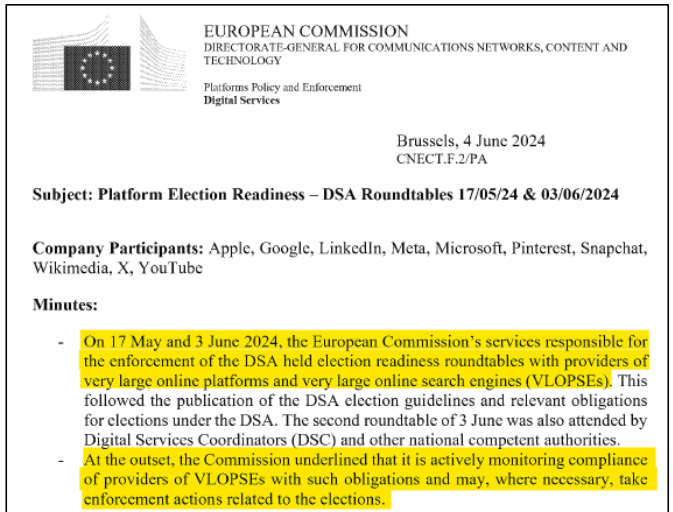
Theoretically, platforms such as Meta and TikTok participate in the system voluntarily. All major social media companies have to sign up to the EU’s ‘Code of Practice on Disinformation’. However, a trove of documents published by the House Judiciary Committee in Washington this year revealed that these companies were threatened – often explicitly – with punishment under the EU’s Digital Services Act (DSA) if they refused to tow the EU line.
The premise resembles a Mafia-style protection racket, with the deputy chief of the commission’s communications directorate telling platforms in 2024 that refusal to sign the codes of conduct “could be taken into account… when determining whether the provider is complying with the obligations laid down by the DSA.”
Read moreThe US has accused the EU of censorship: Here’s how the bloc’s consensus machine works
The DSA is now in force, giving Brussels’ fact-checkers the final say over what constitutes “disinformation” ahead of the election.
Peter Magyar’s allies in Meta
The argument that these fact-checkers favor Magyar is well founded. Over four European elections in which the Rapid Response System was activated, the Judiciary Committee found that fact-checkers “almost exclusively targeted” right-wing and populist candidates and organizations. “Moreover, the requirement that these fact-checkers be approved by the European Commission creates a clear structural incentive for the participants to censor Euroskeptic opinion and content,” the committee noted.
Hungarian MEP Dora David, a former Meta employee and member of Magyar’s Tisza party, boasted last year that “we’ve seen companies change their behavior” based on the threat of DSA enforcement, citing Meta’s removal of pro-Orban content as an example.
The fact-checkers can count on sympathetic staff within the social media companies. After several members of Orban’s Fidesz party claimed that Meta has already started restricting the reach of their Facebook posts, commentators Joey Mannarino and Philip Pilkington identified Oskar Braszczynski as the employee likely responsible. Braszczynski, who works as Meta’s ‘Government and Social Impact Partner for Central and Eastern Europe’, has shared pro-Ukraine, anti-Orban, and pro-LGBT content on his personal social media accounts.