
A 2026 Blue Wave as Big as the One in 2006 No Longer Seems Far-Fetched
This article is part of The D.C. Brief, TIME’s politics newsletter. Sign up here to get stories like this sent to your inbox.
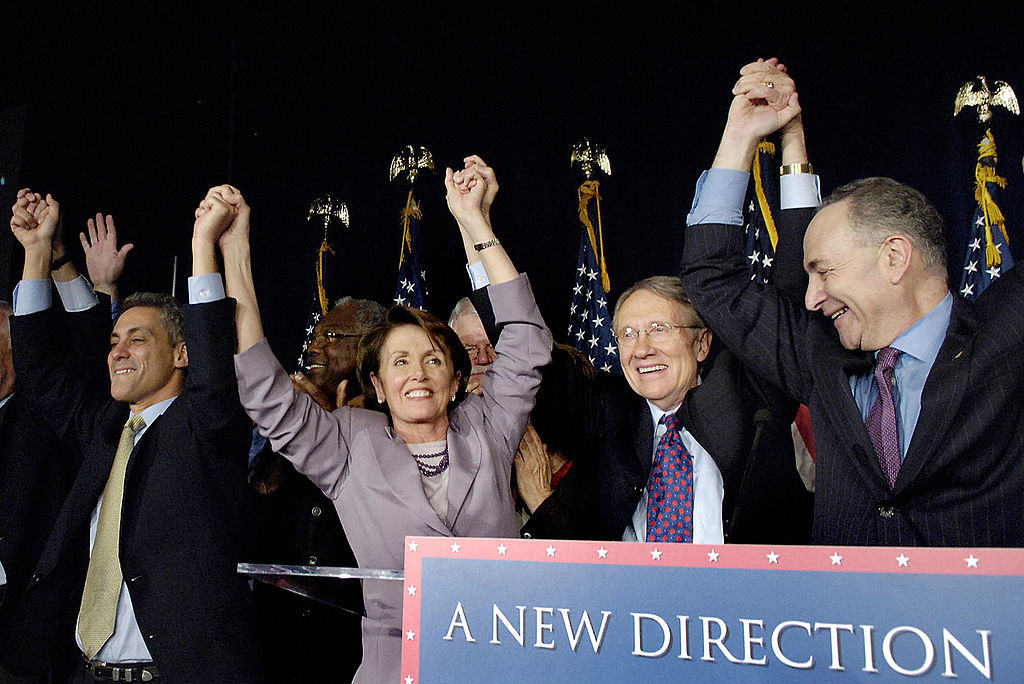
There’s a shift in tone in Washington that’s emerged in the past few weeks. In my conversations on Capitol Hill and K Street alike, it’s impossible to miss. Democrats seem more upbeat and Republicans more deflated as the outlook of the midterm elections grows more lopsided. It’s giving 2006 vibes—the comparison Republicans have been hoping to avoid at all costs.
The parallels are apparent. Twenty years earlier, George W. Bush was in his second term of a presidency mired in a Middle East War and struggling to combat soaring energy costs. Similarly, Donald Trump is posting some of his worst poll numbers yet, with his foreign policy efforts putting him in Richard Nixon territory—all while the price of gas stands at $4.45.
The President’s party typically faces net losses in midterm elections, but 2026 may well be a breed apart. As I’ve been talking with the folks who worked on the 2006 races, they say this feels worse for Republicans; having covered that cycle from over in The Associated Press’ old bureau on K Street, I cannot argue. In that year, Democrats picked up 31 House seats and five seats in the Senate. By August of 2006, Democrats enjoyed a 13-point advantage in CNN’s polling. At this point in 2026, Republicans are quick to point out, Democrats still only have a six-point advantage in CNN polling.
At the same time, Democrats counter, Bush was 22 points underwater in ABC-Washington Post polling at this moment in 2006. The same survey shop showed Trump underwater by 25 points last month.
One more reference point to consider: A record 38 Republicans are retiring from their House seats this cycle. In 2006, that number was 17; the GOP held 12 of those seats.
And, as in 2006, no one in Democratic leadership is promising impeachments. Nancy Pelosi, who led House Democrats that year, was explicit in not approaching voters with promises of impeaching President George W. Bush over his unpopular war in Iraq. “I have said it before and I will say it again: Impeachment is off the table,” Pelosi said after winning the majority.
Trump has warned if Democrats win any control of Congress, it will mean a mangled Washington stuck dealing with the I-Word once again. It’s a route Congress has tried twice before with Trump, and the outcome on a third outing is not likely to be different. He may be right but it isn’t scaring off voters.
Hakeem Jeffries, despite grumbling in his caucus, is using the same playbook as Pelosi did two decades prior. “I’ve made clear from the very beginning that our top priority is going to be to drive down the high cost of living,” the House minority leader said recently. (Rather than impeachment, some Democrats are stressing that what the White House really fears is actual oversight. In fact, The Washington Post reports that White House lawyers are already prepping officials for the potential dynamic of Democrats constantly looking over the shoulder.)
Republicans welcomed the dawn of a second Trump Era with optimism that his fundraising monster would lift all boats. Conversations with senior hands guiding GOP election efforts suggest a different dynamic emerging—with Trump amassing a massive warchest of his own and spending little of it where it would make a difference. His grievances could end up costing two incumbent Republicans their Senate seats, and maybe give one over to Democrats in, of all places, deep-red Texas. National Republicans expect him to support his pals running in North Carolina and Michigan and are hoping he might be persuaded to also spend in Georgia. That’s where the eventual survivor of a three-way GOP primary will be tasked with taking out Democratic Sen. Jon Ossoff before he starts eyeing a promotion.
It’s just as messy in the House, where, given Democrats overperformance in recent special elections, lawmakers are starting to consider the wild scenario of the balance of power flipping before Election Day. (Puck’s Abby Livingtston has a must-read dispatch on that prospect, given there are currently five vacancies.) All the while, some of the GOP’s top recruits decided to stand down given the dour environment for anyone with an “R” after their name on the ballot. House Republicans have tried to change the narrative, rebranding the old-school Young Gun recruitment program as a MAGA Majority.
To be sure, the election picture isn’t entirely rosy for Democrats. The race for California Governor has flown into chaos as a leading Democratic contender bowed out amid allegations of sexual assault and a jumbled primary has not yet sorted itself out (Tuesday’s debate on CNN might offer a reordering of that race.)
The Supreme Court last week released a decision slashing a key Voting Rights Act protection meant to ensure the power of votes coming from minority communities. In effect, the Court said states do not have to take into account racial data when making maps of House districts. Eight states have already enacted new maps ahead of the midterms. The moves give Republicans a slight edge, but legal challenges are on the horizon. Democrats, meanwhile, are looking at matching the GOP’s maximalist approach and see 22 seats in blue states they may target with nakedly political ambition to offset the 19 seats they could lose to Republicans in red states.
Nationally, the enthusiasm gap is epic; according to ABC News-Washington Post polling, Democrats have a 14-point advantage in enthusiasm, the biggest since Democrats pulled up their win in 2006. All the while, the President continues with the kind of threats, actions, and rhetoric that is making life tougher for his nominal friends in the Republican Party. It’s easy to understand why Democrats are eager to punch their screens while Republicans seem, at best, duty-bound.
There remain 182 days until we start actually counting ballots.
Make sense of what matters in Washington. Sign up for the D.C. Brief newsletter.