
What to Know About Trump’s Plan to ‘Guide’ Ships Out of the Strait of Hormuz
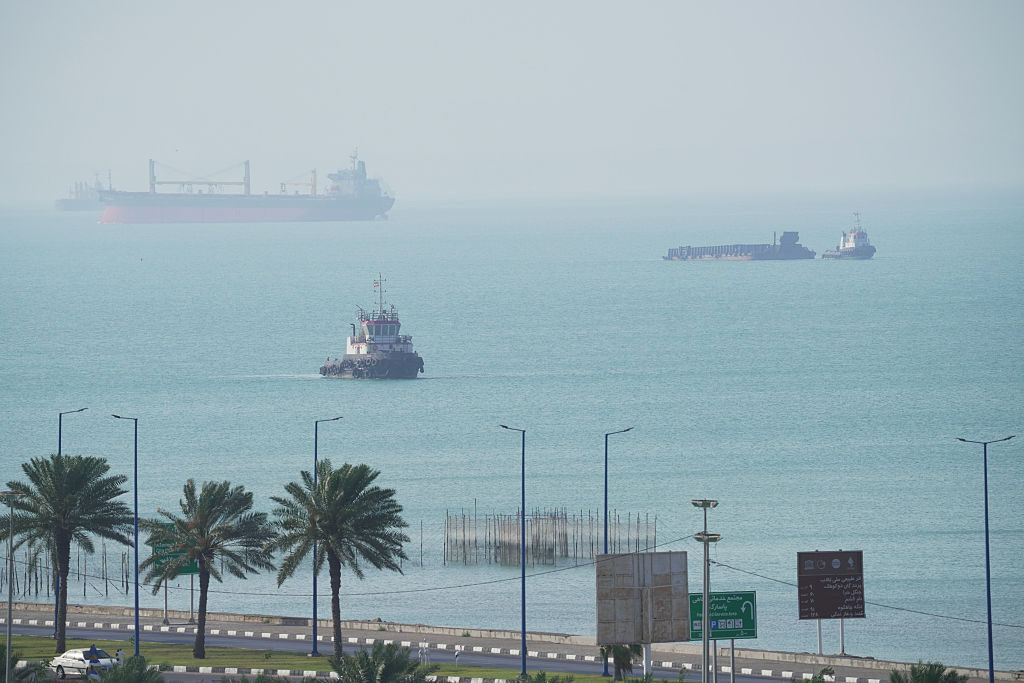
President Donald Trump announced plans to “guide” hundreds of stranded ships out of the Strait of Hormuz, which has been effectively under Iranian control since the U.S. and Israel launched the war against Iran in late February.
Trump’s plan, dubbed “Project Freedom,” was set to begin on Monday morning in the Middle East, Trump said in a Sunday post on Truth Social. The announcement, scant of details on how the plan would work, came after two ships in the area reported attacks.
“Countries from all over the World, almost all of which are not involved in the Middle Eastern dispute going on so visibly, and violently, for all to see, have asked the United States if we could help free up their Ships, which are locked up in the Strait of Hormuz, on something which they have absolutely nothing to do with — They are merely neutral and innocent bystanders!” Trump posted. “For the good of Iran, the Middle East, and the United States, we have told these Countries that we will guide their Ships safely out of these restricted Waterways, so that they can freely and ably get on with their business.”
The effective closure of the Strait has roiled global markets, spiked oil prices, and curtailed the flow of agricultural and petrochemical products around the world.
Read More: War on Iran Could Lead to Global Recession, IMF Warns
Trump called the effort a “Humanitarian gesture on behalf of the United States, Middle Eastern Countries but, in particular, the Country of Iran.” Still, Trump warned that any interference with the process “will, unfortunately, have to be dealt with forcefully.”
But soon after Trump’s announcement, the head of Iran’s National Security and Foreign Policy Commission Ebrahim Azizi said the move would be considered a cease-fire violation.
“Any American interference in the new maritime regime of the Strait of Hormuz will be considered a violation of the ceasefire,” Azizi posted. “The Strait of Hormuz and the Persian Gulf would not be managed by Trump’s delusional posts!”
Here’s what to know about the ongoing stricture of the Strait of Hormuz and Trump’s plan to get ships out.
What is the status of the Strait?
Most commercial traffic through the Strait of Hormuz has been at a halt since early March, when Iran militarized the Strait in retaliation for the U.S. and Israel launching the war on Feb. 28. The Strait is one of the world’s most important energy corridors, with a fifth of global oil trade flowing through it. After the U.S. and Iran agreed to a temporary cease-fire on April 8, the Strait briefly opened but was closed again within hours. Iran said that the Strait would remain closed as long as Israel continued its attacks on Lebanon, which have killed thousands of people.
Trump imposed a U.S. naval blockade of Iranian vessels beginning April 13, which has further crippled Iran’s already weakened economy. Since the start of the blockade, the U.S. has forced 49 commercial vessels to turn back, U.S. Central Command (CENTCOM) said on Sunday. The U.S. military has also seized at least two Iranian-linked oil tankers, while Iran has captured two foreign commercial vessels during the U.S. blockade.
Last month, Trump ordered the U.S. Navy to “shoot and kill” any boats that lay mines in the Strait.
The U.S. also threatened shipping companies with sanctions if they paid Iran to let them transit the Strait. Prior to the U.S. blockade, Iran had struck deals with certain countries allowing their ships to pass through the Strait for a price, while continuing to export its own oil to some countries.
“We think that they’ve gotten less than $1.3 million in tolls, which is a pittance on their previous daily oil revenues,” Treasury Secretary Scott Bessent told Fox News on Sunday.
Bessent said the blockade is ramping up pressure on Iran. “They’re going to have to start shutting in wells, which we think could be in the next week,” as their oil storage fills up with nowhere to go, he said. At the same time, maritime data platform Windward identified a sanctioned Iran-linked tanker transiting the Strait on Monday.
Meanwhile, transit through the Strait has continued to be challenged. On Sunday, ships attempting to cross the Strait of Hormuz faced attacks for the first time since April 22. An unidentified cargo ship traveling to the east of the Strait was attacked by multiple small craft, according to the U.K. military’s United Kingdom Maritime Trade Operations Center (UKMTO). No injuries were reported.
Iran denied any attack, according to Islamic Revolutionary Guard Corps-affiliated news agency Fars. Iranian officials reportedly said that a passing ship had been stopped for a documents check.
Another ship, a tanker, reported being hit by “unknown projectiles” at around 11:40 p.m. local time on Sunday off the coast of Fujairah, United Arab Emirates.
The UKMTO said maritime security in the Strait remains under critical threat.
Since the war began, at least 29 attacks on vessels around the Strait have killed at least 10 seafarers and injured others, according to the International Maritime Organization (IMO).
How many ships are stranded?
According to the IMO, up to 20,000 seafarers have been stranded in the Persian Gulf on around 2,000 vessels, including oil and gas tankers, bulk carriers, cargo ships, and cruise ships, since the war began. A number of ships managed to leave the Strait when it was briefly opened during the U.S.-Iran cease-fire.
Many of the ships are running low on food, drinking water, fuel, and other supplies, the IMO said. Many of the sailors come from India and countries in South and Southeast Asia, according to the Associated Press.
How will the plan work?
The U.S. military will deploy guided-missile destroyers, as well as more than 100 land and sea-based aircraft and 15,000 service members to assist “Project Freedom,” according to CENTCOM. It is not yet clear what exactly the mission will look like.
“Our support for this defensive mission is essential to regional security and the global economy as we also maintain the naval blockade,” CENTCOM commander Adm. Brad Cooper said in a statement.
The Wall Street Journal, citing a senior U.S. official, reported that the mission does not currently involve U.S. Navy warships escorting vessels through the Strait.
Jonathan Hackett, a retired Marine Corps special operations specialist and counterintelligence agent, told Al Jazeera that, even if it wanted to, the U.S. Navy does not have the assets to escort hundreds of ships out of the Strait. “There are only about 12 Navy vessels that could actually conduct some kind of defence of these ships,” he said. “Before the war, there were over 100 transits per day through the Strait of Hormuz. The maths simply does not work out.”
Hackett also said some vessels may not want to take the risk of crossing the narrow Strait even with an escort, especially without a guarantee from insurance companies.
Jennifer Parker, a nonresident fellow at the Lowy Institute and a former Royal Australian Navy officer, told CNN that, for some of those reasons, the mission is unlikely to be a close-escort operation, but rather about “trying to change the situation in the Strait” and be positioned to respond to possible Iranian attacks so that ships “feel safe.”
What happens next?
Even as the U.S. and Iran appear at loggerheads over the Strait of Hormuz, the two countries are in talks to end the war. Tehran is reviewing the U.S. response to its latest 14-point proposal, according to Iranian state media, citing Foreign Ministry spokesperson Esmail Baghaei.
A second round of face-to-face negotiations has stalled since earlier marathon talks fell through last month. The U.S. and Iran have continued to negotiate indirectly via mediators including Pakistan.
Sticking points remain: the U.S. insists that Iran make significant concessions in terms of its nuclear program, including potentially handing over its highly enriched uranium. But, Baghaei said, “at this stage, we are not conducting nuclear negotiations.”
Iran reportedly wants the U.S. to lift sanctions on Iran, end the naval blockade, and cease all hostilities in the region, including Israel’s bombardment of Lebanon. In a Saturday Truth Social post, Trump said he was reviewing the proposal but “can’t imagine that it would be acceptable.”
But the rescue effort threatens to unravel the fragile U.S.-Iran cease-fire and renew military clashes. Iran’s military said in a statement that it “will maintain and manage the security of the Strait of Hormuz with all our might and we announce to all commercial ships and tankers to refrain from any action to transit without the coordination of the armed forces stationed in the Strait of Hormuz so that their security is not jeopardized.”
“We warn that any foreign armed force, especially the aggressive U.S. army, will be attacked if they attempt to approach and enter the Strait of Hormuz,” the military added.
Tehran has insisted that it retain control over the Strait after the war ends. Iran’s Deputy Parliament Speaker Ali Nikzad said on Sunday that Iran “will not back down from our position on the Strait of Hormuz, and it will not return to its prewar conditions.” The U.S. has said it cannot allow Iran to assert control over the Strait. Restricting transit through the waterway would violate the principle of freedom of navigation.
“I am fully aware that my Representatives are having very positive discussions with the Country of Iran, and that these discussions could lead to something very positive for all,” Trump posted on Sunday. “The Ship movement is merely meant to free up people, companies, and Countries that have done absolutely nothing wrong — They are victims of circumstance.”