Tyson Fury Eyes Anthony Joshua Showdown at Wembley After Comfortable Makhmudov Return
Tyson Fury ended his fifth retirement with characteristic flair on April 11 at Tottenham Hotspur Stadium, outclassing Russia’s Arslanbek Makhmudov over twelve rounds to win a comfortable unanimous decision on all three judges’ scorecards, scores of 120-108, 120-108, and 119-109 representing a near-shutout that confirmed the 37-year-old’s enduring class even after 16 months away from the sport.
The fight itself was always designed as a controlled re-entry rather than a serious examination of where Fury stands in the heavyweight hierarchy, with Makhmudov’s record of stoppage losses against Agit Kabayel and Guido Vianello making clear that the Russian’s 6-foot-7 frame matched Fury physically but nothing else about him presented a credible threat to a former undisputed world champion operating at a fraction of full capacity.
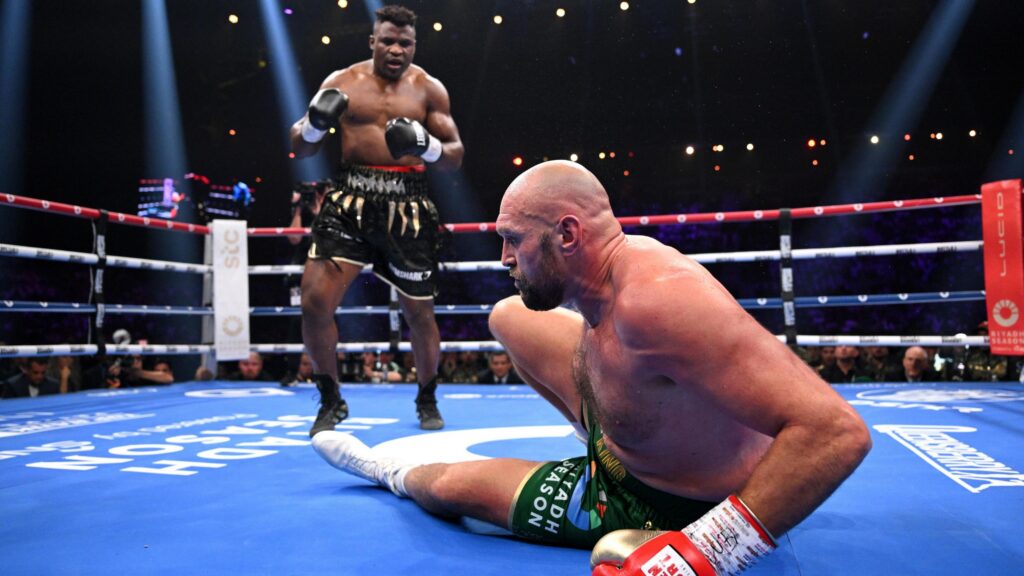
Makhmudov troubled Fury briefly in the opening round with a sharp overhand right, prompting a cautious early passage from the returning champion, but by the third round the pattern of the contest had been firmly established, with Fury switching stances fluidly, landing a one-two off Makhmudov’s chin, and visibly enjoying himself as his opponent’s legs buckled momentarily under a hard right hook that drew an audible gasp from the crowd inside the stadium.
The most significant moment of the evening came not during the fight itself but immediately after it, when Fury grabbed the microphone and bellowed a direct challenge at Anthony Joshua, who was seated at ringside watching the man he has spent the better part of a decade failing to agree terms with: “I want to give you the fight you’ve all been waiting for. I want you, AJ, Anthony Joshua. Let’s give the fight fans what they want, the Battle of Britain.”
Joshua’s response combined defiance with theatre, refusing to step forward and face off, telling Fury: “Tyson, you’re a clout chaser. I’ve never had no problem getting into the ring with you. I punched you up when we were kids, and after watching you here tonight, I’ll punch you up again. With all due respect, tonight is your night, and you know I’ll sit across that ring from you in due time. You ain’t going to tell me what to do. I’ve been chasing you for the last 10 years. I’m the boss. You work for me. I’m the landlord. Remember that.”
The spectacle of their post-fight exchange confirmed what most serious boxing observers have concluded: a Fury versus Joshua fight carries commercial weight that neither man’s current standing in the heavyweight division would strictly justify on sporting merit alone, but the British public’s appetite for the domestic showdown remains enormous and the financial logic for both sides is straightforward.
Promoter Eddie Hearn has since outlined a framework in which Joshua fights a tune-up opponent in July before the long-awaited Fury clash in November, a timeline that assumes both men stay healthy and that negotiations conclude before either finds a reason to pull out of the arrangement, a caveat that boxing’s history of collapsed negotiations makes genuinely necessary to include.
Fury was emphatic in a post-fight press conference that his list of acceptable opponents is short: “I’m not interested in Daniel Dubois, I’m not interested in Moses Itauma. They are all great fighters and I wish them all the best of luck in the world but I want to fight Anthony Joshua, that is it. Or, if AJ don’t want it, then let’s get Usyk in the trilogy.”
The Usyk alternative is worth taking seriously, given that the Ukrainian’s two victories over Fury in 2024 defined the most recent chapter of the heavyweight division and that a third fight would provide genuine sporting resolution to an unfinished story, but Fury’s preference is clearly for the British showdown and the Joshua camp’s statements since April 11 suggest a November fight at Wembley is the most likely destination.
Fury made his ringwalk on the night wearing shorts designed in the style of Ricky Hatton’s ring gear, playing out Hatton’s signature Blue Moon music as a tribute to his close friend who died last year, a gesture that generated one of the most emotionally charged receptions heard inside a British boxing venue in years and underlined that beyond the promotional noise and the contractual maneuvering, Fury’s personal story carries a humanity that makes him genuinely impossible to ignore even for those who have grown weary of the serial retirements.
The Sun reported this week that Joshua could sign his side of the Fury fight deal as early as next week, a development that would move the battle of Britain from plausible hypothesis to confirmed reality and set up what would be the most commercially significant domestic heavyweight fight since Lennox Lewis faced Frank Bruno at Wembley in 1993.
The post Tyson Fury Eyes Anthony Joshua Showdown at Wembley After Comfortable Makhmudov Return appeared first on Gooner Daily.