Gas hubs hit in Iran and Qatar: How close is a global supply crisis?
Israel’s strike on Iran’s South Pars gas field and Tehran’s response signal a shift from bombing bases to targeting the backbone of global gas supply
Israel’s recent strike on Iran’s South Pars gas field and Tehran’s retaliation on key energy infrastructure in several Gulf countries is more than just another escalation of the war roiling the Middle East.
What began as a campaign of decapitation strikes and base‑to‑base missile exchanges has escalated into dueling attacks on energy infrastructure that risks igniting a major energy crisis globally whose effects could reverberate for years.
RT takes a look at what this ominous development means for energy markets and how close the world may be to a full-blown crisis.
Here’s why these attacks matter globally
Although the natural gas reservoir housing South Pars is the world’s largest, Iran’s ability to export gas is limited by sanctions. Therefore, damage to the field or related facilities is mainly a domestic issue. The majority of the gas extracted from South Pars goes to the domestic market, although some is exported to Iraq and Türkiye.
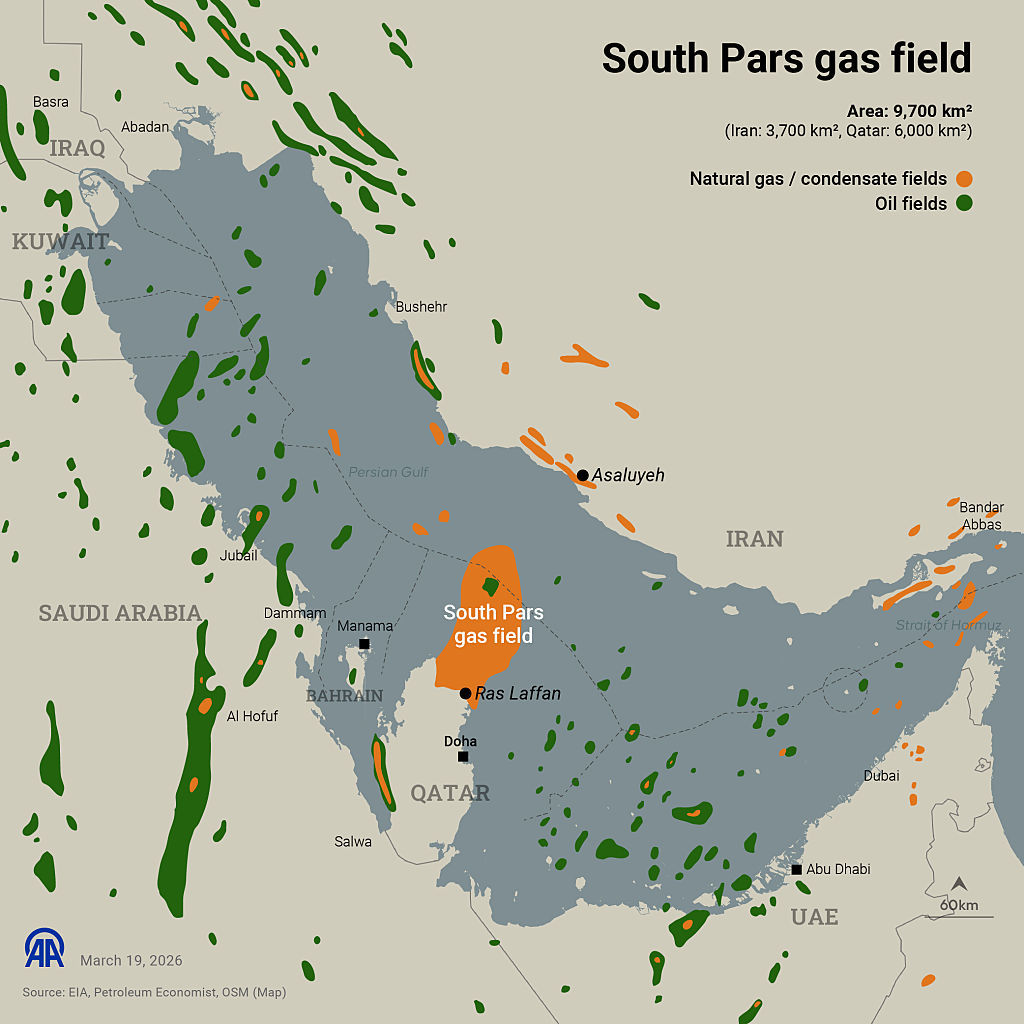
Israel struck the South Pars field and the infrastructure that services it at the nearby Asaluyeh processing hub on March 18. Iran retaliated with strikes on Saudi Arabia, the UAE and, most critically, Qatar’s Ras Laffan Industrial City, the world’s largest LNG export hub.
More concerning globally is not the South Pars strike but the retaliatory attack against the LNG hub at Ras Laffan. This is where the gas from the North Field, which is the Qatari side of the same reservoir that South Pars taps, is processed. The North Field – also called the North Dome – is responsible for about 20% of global LNG supply, practically all of which is processed at Ras Laffan. Qatar has admitted that the attacks caused “significant damage.”
While the complex had already been largely shut since early March due to the war, analysts at Wood Mackenzie now warn that damage to the hub could delay any restart and “fundamentally reshape the global LNG outlook.”
Rising LNG prices would be particularly bad news for Europe, which has become heavily reliant on LNG in light of its rejection of Russian pipeline gas. Other major consumers of LNG include Japan, Türkiye, and India. The US, as a LNG exporter, would benefit from rising prices.
The damage could be long term
Importantly, unlike many other leading gas fields, the geologically unified reservoir feeding South Pars and the North Field is only at 10% depletion, meaning 90% of the gas is still there. The significance of this cannot be overstated. The gas from the world’s largest reservoir – and one expected to play a critical role in meeting future global demand – may not be extractable if the infrastructure on both sides is destroyed. This becomes an issue not just of near-term prices but the state of structural physical supply.
Read moreTrump threatens to ‘blow up’ world’s largest gas field
Any sustained disruption to Qatari production would reverberate across the global gas market. Losing even part of Qatari output for an extended period would tighten supply, drive prices higher, and leave import‑dependent economies scrambling for alternatives.
Unfortunately, alternatives may be scarce. The LNG market was tight even before the war. US LNG export capacity was already near its limits, meaning the country’s ability to offset lost Persian Gulf supply is constrained.
Meanwhile, repairing damaged LNG facilities is a highly complex and costly undertaking that could take years. Projects implemented in the Ras Laffan Industrial City cost $70 billion to build, according to Qatar News Agency.
So even if a ceasefire is reached today, the damage already sustained could reverberate for years.
Global markets under strain
Energy prices have surged due to the conflict in general and even more so in light of the attack on South Pars and the Iranian retaliation. This also comes as the Strait of Hormuz, a critical artery that carries about a fifth of the world’s seaborne oil, remains essentially closed.
The South Pars-Ras Laffan strikes drove European benchmark gas prices up about 35% in a single day. Oil prices rose more than 5%. Tehran’s suspension of gas exports to Iraq and potential cuts to supplies for Türkiye threaten to tighten regional markets further, while Qatar’s warning that it may declare force majeure on long‑term LNG contracts – including deliveries to Europe and Asia – raises the prospect of a cascading supply shock.