
Patriots film review: Lessons learned for Drake Maye from Super Bowl LX
The story of the 2025 Patriots was an unexpected, undisputed success.
Mike Vrabel and Drake Maye powered a franchise’s rebirth. A 14-win regular season led into a Super Bowl run. The end of this story, though, was a multi-layered failure.
The Patriots got out-coached, out-played and out-classed in Super Bowl LX. Vrabel made a handful of curious decisions, and his offensive staff repeatedly failed to adjust or stress an elite Seattle defense. Were it not for a fourth quarter full of empty-calorie counting stats, Drake Maye’s performance would have been regarded as one of the worst in Super Bowl history.
Advanced metrics put Maye there anyway.
But the Patriots’ problems did not start, nor end with him. The Seahawks immediately generated free rushers against two of the Pats’ more common protections, specifically with double-edge pressure and overload blitzes through the “B” gap (space between the guard and tackle). Slot cornerback Devon Witherspoon blitzed seven times, recorded a sack, caused Maye’s late pick-six and hit him another time.
Seattle followed those same rush paths over and over to reach Maye, limiting his impact as a scrambler and toying with his internal clock as a passer. That’s on coaching. Rookie left tackle Will Campbell has since become the face of the Patriots’ protection woes in the Super Bowl, and, yes, his team-high eight pressures deserve a heap of criticism. He was awful.
But the Seahawks beat the Patriots schematically as badly as they did physically, and every offensive lineman allowed multiple pressures, including four who let up a sack.
Defensively, the Pats held their ground. They applied sufficient pressure on Sam Darnold, who never broke under a cascade of creative blitzes.
Here’s what else the film revealed about the Pats’ Super Bowl loss:
Drake Maye
27-of-43 for 295 yards, 2 TDs, 2 INTs, 6 sacks, 37 yards
Accurate throw percentage: 65.4%
Under pressure: 6-of-13 for 75 yards, TD, INT, 6 sacks, 38 rushing yards
Against the blitz: 3-of-6 for 18 yards, INT, sack
Behind the line: 8-of-8 for 68 yards
0-9 yards downfield: 13-of-18 for 94 yards, TD
10-19 yards downfield: 3-of-8 for 48 yards, INT
20+ yards downfield: 3-of-7 for 85 yards, TD, INT
Notes: The greatest obstacle between Maye and the clean, boring game Darnold played was his play under pressure.
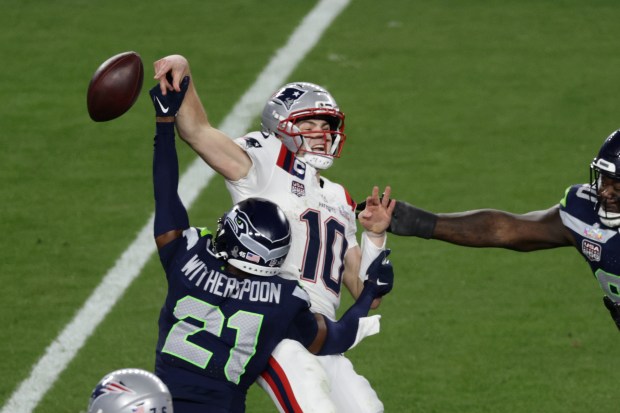
Both quarterbacks faced high pressure rates and posted identical average snap-to-throw times, per Next Gen Stats, but Maye took six sacks to Darnold’s one. His inability to convert a few of those losses into throwaways set the Pats back on multiple drives, as did the Seahawks’ clever blitz tactics. Maye had three turnovers under duress (zero for Darnold), looked down at the rush and slid the protection the wrong way on his pick-six, one of the few times Seattle blitzed him in the second half.
Maye’s consistent, bordering on predictable, cadence in the second half helped the Seahawks time a few blitzes right after he clapped for the snap. The Seahawks blitzed Maye initially with the idea of affecting his internal clock, just as the Chargers and Broncos did early in prior playoff games, and succeeded. In addition to the blitz pressure, their coverage disguises rendered some of Maye’s go-to indicators — like a defender following a motioned receiver across the formation as a man-to-man coverage tell — useless. That’s good defensive coaching.
Drake Maye makes promise to Patriots fans after postseason struggles
Though Seahawks safety Julian Love, who caught Maye's second interception, was caught on a live mic saying Maye hesitated slightly on that play before unloading an errant deep throw toward his intended target. Maye's inaccuracy also spread to third-down misses for DeMario Douglas and Kayshon Boutte in the third quarter and a bad miss to Hunter Henry in the first half. Those same pass-catchers authored a big chapter in the book of Patriots' offensive failures Sunday, most glaringly with poor separation, rough routes and minimal yards after the catch.
Between that, the poor pass protection and subpar coaching, Maye was at a disadvantage all night. His team let him down. But independent of his surroundings, Maye did not play well enough to win. And as the quarterback, that's often all that matters.
Critical areas
Turnovers: Patriots 3, Seahawks 0
Explosive play rate: Patriots 7.5%, Seahawks 7.1%
Success rate: Patriots 41%, Seahawks 33%
Red-zone efficiency: Patriots 1-1, Seahawks 1-4
Defensive pressure rate: Patriots 40%, Seahawks 43.4%
Offense
Game plan
Personnel breakdown: 80% of snaps in 11 personnel, 10% of snaps in 12 personnel, 1.5% of snaps in 21F personnel, 1.5% of snaps in 21H personnel, 7% of snaps in 22 personnel.***
Personnel production: 41.5% success rate in 11 personnel, 0% success rate in 12 personnel, 100% success rate in 21F personnel, 100% success rate in 21H personnel, 50% success rate in 22 personnel.
First-down down play-calls: 65.5% pass (40% success rate), 34.5% run (20% success rate)
Play-action rate: 11.3%
You almost wondered if Josh McDaniels and Co. started game-planning a couple nights before kickoff.
The Pats executed a straightforward plan with the aforementioned protection issues, getting pantsed early by a five-down front, where Seattle dropped its defensive tackles and sent blitzers off each edge into a backfield where Rhamondre Stevenson had to choose between them. Later, the Seahawks repeatedly fired two blitzers through the same B gap, out-numbering the weakside of the O-line where center Garrett Bradbury often turned away from, and again overwhelmed Stevenson 2-to-1 in the backfield.
That led to a couple sacks and several pressures, most glaringly in the first and fourth quarters. Protection aside, McDaniels' bland plan didn't do enough to help his players, most of whom were overmatched in 1-on-1s against an uber talented Seattle defense. The Pats mostly worked from 11 personnel (what Seattle wants), called one snap of jumbo personnel (six offensive linemen), gained 21 yards on that snap and never returned to it. They never worked from empty formations, a minor weakness for the Seahawks. No trick plays. No quarterback option runs.
McDaniels wisely tried to spark his run game with plays Seattle had been weakest against, draws and duo, but predictably, the Seahawks were able to contain one of the league's most inconsistent rushing attacks. He also had a few well-timed calls to break the Seahawks' two-high coverages and bracket coverage of the slot receivers. But ultimately, the Pats needed more plays in space for players like TreVeyon Henderson and DeMario Douglas, or just more explosive players like them. Because playing these Seahawks straight up was a bad idea.
Player stats
Broken tackles: WR DeMario Douglas 3, RB Rhamondre Stevenson 2, RB TreVeyon Henderson, TE Hunter Henry
Pressure allowed: LT Will Campbell 8 (sack, QB hit, 6 hurries), RT Morgan Moses 4 (sack, 3 hurries), Team 4 (sack, QB hit, 2 hurries), RG Mike Onwenu (3 hurries), LG Jared Wilson (2 sacks), C Garrett Bradbury 2 (sack, hurry)
Run stuffs allowed: Team 2, RT Morgan Moses
Drops: N/A
‘It sucks’: Patriots OT Will Campbell opens up about Super Bowl play, criticism
Notes
- Rookie left tackle Will Campbell got powered into the backfield on the opening snap. He gave up just two more pressures through the end of the third quarter, so of the damage he allowed was when the game was out of hand, but it's worth noting most playoff opponents successfully bull-rushed him early to set up other rushers.
- Does Campbell need to change positions? That question is wildly premature from this view, but there's no question there are wrinkles to be ironed out in his game, including how he anchors against power.
- Left guard Jared Wilson had the worst snap of the day against a power rush, getting bulldozed by Rylie Mills while Mills reached around for a sack of Maye. Wilson's development arguably bears watching as much as Maye's, given how Seattle successfully picked on both of them.
- Right tackle Morgan Moses pass-protected as poorly as Campbell did until late in the game. His future, entering his age-35 season, bears watching.
- Out wide, Kayshon Boutte put forth his worst game of the season. He caught one of five targets, and Seattle cornerback Josh Jobe bodied him out of bounds on a third-down target in the third quarter. Boutte represented one of the Pats' few paths to explosive plays, and the Seahawks shut him down.
- The Patriots seemed to target Jobe often, but none of their receivers were up to the task of winning consistently versus single coverage aside from Mack Hollins. Stefon Diggs drew some extra attention, but never seriously threatened Seattle.
- A quiet game for Hunter Henry, and downright bad night for No. 2 tight end Austin Hooper, a pending free agent. The Pats would be wise to invest in this position this offseason.
- Credit to Rhamondre Stevenson for running hard into a brick wall. His vision and blitz pickup continued to separate him from TreVeyon Henderson, though both averaged two-plus yards per carry after contact. Stevenson also did well as a pass-catcher and finished with more postseason receiving yards than Diggs.
Defense
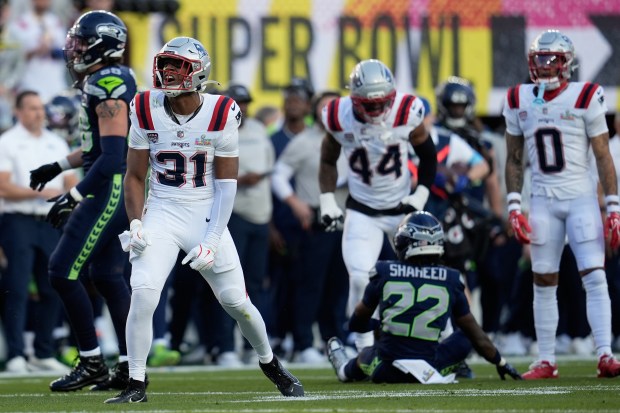
Game plan
Personnel breakdown: 46.5% three-corner nickel, 36.5% base, 8.5 goal-line, 8.5% dime****
Coverage breakdown: 63% zone, 37% man
Blitz rate: 54%
Blitz efficacy: 43.5% offensive success rate and 5.7 yards per play allowed
Defensive play-caller Zak Kuhr cycled through a variety of coverages, pressures and disguises to fool Sam Darnold, but there were a few basic tenets underneath all the window dressing of the Patriots' last game plan.
They worked to stop the run through base personnel and/or a five-down front that gapped out Seattle's preferred outside zone scheme. In coverage, Kuhr slightly favored single-high defenses to add an extra body into the box, while Christian Gonzalez also often shadowed star Seahawks receiver Jaxon Smith-Njigba. And the Pats blitzed Darnold on more than half of his dropbacks to force the one-time turnover machine into a fumble or interception.
Whoops.
Darnold's mobility (read: sack avoidance) was a major factor in nullifying the Pats' high pressure rate, something Maye could learn from in time. But what hurt the Patriots most was their top-ranked play-action pass defense cracking against what appeared to be the same outside zone run play they had successfully contained all season and that night against Seattle. Instead, at his 16-yard line in the fourth quarter, linebacker Jack GIbbens lost tight end AJ Barner after Barner had motioned over to what appeared to be a strongside outside zone run, which the Seahawks had previously checked to multiple times. Barner then zipped right by him for an easy end-zone grab.
This was a major battleground in this game, considering how many explosive plays and touchdowns Seattle's offense derived from play-action passing and how well the Patriots had stopped it most of the year. Two other problems for the Pats: Seattle successfully threw against their goal-line personnel grouping with just three defensive backs breaking out of halftime, when Seattle marched over a 69-yard field goal drive. The Patriots also generated a single pressure in the second half without blitzing.
Barner's touchdown was Seattle's only end-zone trip, however, thanks mostly to Gonzalez's work on Smith-Njigba. Kuhr wisely put his No. 1 corner on the league's leading receiver, but did not task him with basic man-to-man throughout the game, which would have become a simple coverage tell. Even when the Patriots did play man, their defensive backs would sometimes "bump" assignments to pass Smith-Njigba off whenever he would go in motion to maintain their leverage. Seattle had a hard time establishing a rhythm for their No. 1 receiver, who finished with one catch at Gonzalez's expense.
Player stats
Pressure: DL Milton Williams 5 (sack, 3 hurries), OLB K'Lavon Chaisson (QB hit, hurry), OLB Harold Landry 2 (QB hit, hurry), S Jaylinn Hawkins 2 (QB hit, hurry), LB Robert Spillane (QB hit), LB Christian Elliss (QB hit), OLB Anfernee Jennings (QB hit), S Craig Woodson (hurry)
Run stuffs: Team 4, Woodson 2, Chaisson
Pass deflections: CB Christian Gonzalez 3, Woodson 2, Williams, Jennings
Missed tackles: Williams 4, Chaisson 2, Hawkins 2, Woodson, Elliss, Spillane, Jennings, S Dell Pettus, DL Christian Barmore, LB Jack Gibbens, DL Cory Durden, CB Marcus Jones, LB Jahlani Tavai
Notes
- Christian Gonzalez kept this from becoming a Super blowout. His two Sistine chapel, fingertip-extension deflections were displays of elite cornerback play and freaky athleticism.
- Gonzalez's second deflection in front of Jaxon Smith-Njigba near the goal line just before halftime would have been a touchdown instead with a perfect throw, but credit to Gonzalez for catching up.
- Milton Williams was the Patriots' only regular pass rusher who generated consistent pressure. He beat Seahawks right guard Anthony Bradford on his sack, one of the more lopsided matchups in this game.
- So where was Christian Barmore? Bouncing around the front, as the Patriots mixed their fronts and coverages. But zero pressure from one of their highest-paid defenders hurt a lot. He also lost contain on a key Darnold scramble that helped power a field goal drive.
- More hurt: a season-high 18 missed tackles. Veteran safety Jaylinn Hawkins whiffed on a sack and Kenneth Walker's 30-yard run in the second quarter, one of two explosive runs on that series that led to a field goal.
- Walker reached the edge on an outside run play that complemented Seattle's base outside zone: G-lead, where the playside guard pulls ahead of the running back and, in this case, crunched K'Lavon Chaisson as the nearest edge defender. The Pats needed more from Chaisson there and as a pass rusher (two pressures).
- Otherwise, the run defense was mostly terrific. Coordinated, violent yet controled. Seattle had a 25% rushing success rate, and broke out for a few runs because of Walker's vision and speed.
- Rookie safety Craig Woodson was spectacular with 10 tackles, three TFLs and two pass breakups. He was exactly who the Patriots needed versus a run-heavy offense that tried to exploit the middle of the field on crossers, save for the aforementioned 30-yard run where he got caught in traffic.
- Seattle picked on Marcus Jones and inside linebacker Robert Spillane in coverage. Jones was an obvious target who lost a few key battles with Cooper Kupp that led to first downs.
- In his return from injury, Harold Landry split his 14 snaps almost evenly between run and pass defense. He gave the Pats a nice jolt on the edge.
- Speaking of the edge, Anfernee Jennings had one pressure, a pass deflection and strong run defense after Seattle's opening 10-yard pickup. Jennings really became an underrated force late in the year.
- Tough outings for defensive tackles Khyiris Tonga and Cory Durden.
- Dell in dime: Dell Pettus, the Patriots' third safety, replaced linebacker Christian Elliss more than he has this season on obvious passing downs. He even covered Smith-Njigba for a snap when the receiver aligned in the backfield.
*Explosive plays are defined as runs of 12-plus yards and passes of 20-plus yards.
**Success rate is an efficiency metric measuring how often an offense stays on schedule. A play is successful when it produces positive EPA (Expected Points Added).
***11 personnel = one running back, one tight end; 12 personnel = one running back, two tight ends; 13 personnel = one back, three tight ends; 21 personnel = two backs, one tight end; 21H = two halfbacks, one tight end; jumbo personnel = two backs, two tight ends, six offensive linemen.
****Base defense = four defensive backs; nickel = five; dime = six, dollar = seven.