
How Long Does a Wheel Alignment Take?
 Sitting in a mechanic’s waiting room can feel like watching paint dry. You check your watch, scroll through your phone, and wonder if the service advisor forgot about you. If you are there for a wheel alignment, you likely just want to know one thing: When can I leave?
Here is the short answer: A standard wheel alignment usually takes 30 to 60 minutes. However, if you drive a truck, a lifted 4×4, or a luxury car with advanced driver-assist systems, you should plan for 60 to 90 minutes. While it might seem like a long time for a “routine check,” this service is critical for the long-term health of your vehicle.
Neill Auto Body provides essential information about tire and wheel alignment, helping drivers plan their visit and prevent uneven tire wear, poor handling, and steering issues caused by misaligned wheels. A proper alignment doesn’t just straighten your wheels; it recalibrates your entire suspension system to ensure safety and efficiency.
What Is a Wheel Alignment and Why Does Your Car Need It?
Many drivers confuse wheel alignment with tire rotation, but they are very different services. A rotation moves your tires to different spots on the car to ensure they wear evenly. An alignment adjusts the suspension system—the complex network of springs, shocks, and linkages that connects your vehicle to its wheels.
When your suspension is aligned correctly, your tires make optimal contact with the road. This prevents your car from pulling to the right or left and stops your tires from wearing out prematurely. If you hit a pothole or a curb recently, you likely knocked this delicate system out of whack.
The Technical Breakdown: Camber, Caster, and Toe
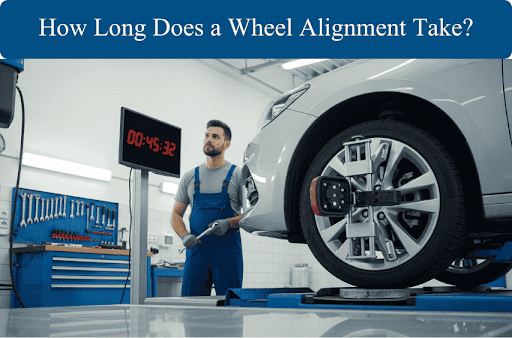
To align a vehicle, a technician clamps sensors onto each wheel and measures them against the manufacturer’s specifications. They adjust three specific angles to ensure your car drives straight:
- Camber: This is the inward or outward tilt of the tire when you look at it from the front. If the top of the tire leans in, that’s negative camber; if it leans out, it’s positive. Too much tilt wears down one side of your tread rapidly.
- Caster: This measures the angle of your steering axis when viewed from the side. Positive caster helps your steering wheel return to center after a turn and keeps the car stable at highway speeds.
- Toe: This is the most common adjustment. It refers to the direction your tires point relative to each other. “Toe-in” means the fronts of the tires point toward each other (like being pigeon-toed), while “toe-out” means they point away.
Adjusting these angles requires precision. A technician must physically turn adjustment bolts under the car while watching a digital monitor to get the specs exactly right.
How Long Does a Wheel Alignment Take on Average?
The time you spend at the shop depends heavily on what you drive and which wheels need attention. Let’s break down the typical timeframes so you can plan your day effectively.
The Quickest Option: Two-Wheel Alignment (30–45 Minutes)
A two-wheel alignment, often called a front-end alignment, is the fastest service available. In this procedure, the technician only adjusts the front axle. This is most common on older vehicles or heavy-duty trucks with a solid rear axle where rear adjustments aren’t physically possible. Since the technician only needs to measure and turn bolts on the front two wheels, you can often be back on the road in under 45 minutes.
The Standard Service: Four-Wheel Alignment (60–90 Minutes)
Most modern cars, SUVs, and trucks require a four-wheel alignment. This is especially true for vehicles with independent rear suspension or all-wheel drive (AWD).
During this process, the technician must first align the rear wheels relative to the vehicle’s “geometric centerline.” This ensures the car doesn’t “dog track” (drive sideways like a crab). Once the rear is properly set, they align the front wheels to match. Because this involves double the work and more complex geometry, it naturally takes longer than a simple front-end job.
The Complex Case: Performance and Lifted 4×4 Vehicles (90 Minutes+)
If you drive a modified vehicle, throw the standard time estimates out the window. Trucks with lift kits, leveling kits, or oversized off-road tires present unique challenges that extend the service time significantly.
Factory specifications often no longer apply to modified suspensions. The technician may need to calculate custom specs to ensure the vehicle drives safely. Additionally, accessing the adjustment points on a lifted truck can be more physically demanding, and large off-road tires are heavier and harder to manipulate. If you have a modified rig, ask the shop beforehand if they specialize in custom alignments to avoid a wasted trip.
Factors That Can Make a Wheel Alignment Take Longer
While a 60-minute window is standard, real-world conditions often intervene. Several factors can turn a routine alignment into a longer service appointment, and understanding them can save you frustration at the shop.
Damaged or Worn Suspension Components
An alignment is only as good as the parts holding it together. If a technician finds a loose tie rod, a worn ball joint, or a cracked control arm bushing, they cannot proceed. Adjusting a broken part is pointless because the setting won’t hold. In these cases, the worn parts must be replaced first, which adds significant labor time to the ticket.
Rusted or Seized Bolts
On older vehicles—especially those driven in areas with road salt or high humidity—adjustment bolts often rust in place. A technician cannot simply force them without risking breakage. They must use penetrating oil, heat (torches), and patience to free the seized hardware. This process can easily add 30 minutes or more to the job.
Technician Expertise and Equipment
Not all shops are created equal. A specialized shop using a modern laser alignment machine can measure and adjust angles much faster than a general mechanic using older optical or manual methods. The expertise of the technician also matters; a seasoned pro knows exactly how much to turn a tie rod to get the toe angle perfect on the first try.
Tire Balancing vs. Alignment: What’s The Difference?
Many drivers use the terms “alignment” and “balancing” interchangeably, but they solve different problems.
- Wheel Alignment: Adjusts the angles of the tires to ensure they point in the right direction. It fixes pulling, drifting, and uneven tread wear.
- Tire Balancing: Adjusts the weight distribution around the tire and wheel assembly. Small weights are added to the rim to ensure the tire spins without wobbling. It fixes vibrations in the steering wheel or seat at high speeds.
Can they be done together? Absolutely. In fact, many shops recommend doing both when you get new tires. Just know that adding balancing to your service will typically add another 30 to 45 minutes to the total appointment time.
Signs Your Vehicle Needs a Wheel Alignment
You don’t always need to wait for a scheduled service interval to get an alignment. Your car will often tell you when something is wrong. Watch for these clear warning signs:
- Vehicle Pulls to One Side: If you are driving on a straight, flat road and have to constantly fight the steering wheel to keep the car from drifting into the next lane, your alignment is off.
- Off-Center Steering Wheel: When you are driving straight ahead, the logo on your steering wheel should be level. If it is crooked or tilted to the left or right, your steering geometry needs adjustment.
- Uneven or Rapid Tire Wear: Take a look at your front tires. Is the inside or outside edge worn down significantly more than the center? This is a classic sign of improper camber or toe settings.
- Squealing Tires: If your tires screech when you turn a corner at low speeds, it often means they are being “dragged” sideways rather than rolling smoothly due to poor toe alignment.
What Should You Know About Wheel Alignment Cost?
The cost of an alignment is generally proportional to the time and labor required.
- Standard Alignment: Expect to pay between $75 and $100. This usually covers a basic four-wheel alignment for a standard sedan or small SUV.
- Performance/Custom Alignment: For modified vehicles, lifted trucks, or sports cars requiring specific specs, prices can range from $150 to $200+.
- The “Hidden” Costs: Remember, if the technician finds broken parts (like those rusted tie rods mentioned earlier), the cost will increase to cover the repairs. However, fixing these issues now saves you from catastrophic failure later.
Is It Really Worth the Wait?
Is spending an hour in a waiting room worth it? The answer is a resounding yes.
Proper wheel alignment is an investment that pays for itself. By ensuring your tires roll straight, you significantly reduce rolling resistance. This improves your fuel efficiency (gas mileage) because your engine doesn’t have to work as hard to push the car forward. More importantly, it extends the life of your tires by thousands of miles, saving you from prematurely buying a new set of rubber.
So, bring a book, catch up on emails, or just enjoy the coffee. That hour you spend waiting is adding months of life to your tires and keeping your drive safe and smooth.
The post How Long Does a Wheel Alignment Take? appeared first on Gauge Magazine.