Lucas: Castro and Trump the ultimate odd couple we missed
It’s too bad Cuba’s Fidel Castro is not around.
Donald Trump could have worked out a deal with him.
Even given the staunch communist that he was, Castro would have realized that after Venezuela, the jig was up, though the Cuban dictator would still have delighted in needling the U.S.
But the communist revolutionary died in 2016 at age 90, and Cuba, already a communist/socialist economic backwater, descended into the basket case it is today.
While Fidel was a well-known, worldwide political celebrity, one would be hard-pressed to name the individual who runs Cuba today.
It is Miguel Diaz-Canel, 66, who succeeded Raul Castro, Fidel’s younger brother, in 2018. Raul ran Cuba after Fidel stepped down for health reasons in 2008.
Diaz-Canel was born after the 1959 Cuban Revolution and, although trained as a communist operative, never knew Fidel.
Which is too bad. Fidel could have taught him a thing or two when it comes to dealing with American presidents and surviving, even after the 1960 Bay of Pigs invasion.
Up until now, Diaz-Canel had a strong relationship with Maduro, whose Venezuela was a vital source of cheap oil and economic and military assistance to Cuba.
Those days are over because Venezuelan socialist dictator Nicolas Maduro now sits in a jail cell in New York awaiting trial on numerous drug-related charges
And Cuba, a closed communist police state, has lost Venezuela, its major benefactor.
“There will be no more oil or money going to Cuba — Zero,” Trump wrote on Truth Social the other day. “I strongly suggest that they make a deal before it’s too late.”
Trump added, “Cuba is ready to fall … Cuba has no income. They got all of their income from Venezuela, from the Venezuelan oil. They’re not getting any of it. And Cuba is literally ready to fall.”
In response, Diaz-Canel said, “ Cuba is free, independent and sovereign nation. Nobody dictates what we do.”
Right. That’s what Maduro said.
Fidel might have said the same thing, too, if he were around, but he would have worked the back channels well.
This is not to make a saint out of Castro. He was far from it. But he knew how to deal with U.S. Presidents and survive.
I met Castro in Havana in 1984 during a trip to Cuba covering Jesse Jackson, the Chicago left-wing Democrat who was running for president. Jackson was in Cuba to seek the release of some 22 Americans held captive as political prisoners.
Jackson and the press covering him ended up in Cuba after visiting Panama, Nicaragua, and El Salvador. Havana back then was as dismal as it is today. Time stopped in Cuba after the communists took over.
After successfully negotiating with Castro over the prisoners, Fidel threw a lavish reception for Jackson, complete with wine, champagne, booze and food that was unimaginable to the average hungry Cuban.
Castro was standing with Teofilo Stevenson, the great Cuban three-time Olympic heavyweight boxing champion, when I met him at the reception.
Stevenson, at the time, was just as famous as Castro. Boxing promoters wanted him to fight Mohhamed Ali for millions in fight money. He never did.
Stevenson had a crushing handshake. He spoke no English and my Spanish was limited to “Quanto” and “No habla espanol.”
Castro, as big, strapping, and charismatic as Stevenson, did speak English, and I interviewed him along with other reporters. He handed out Cuban cigars. It was hard not to be taken by the man. He had a big and charming personality.
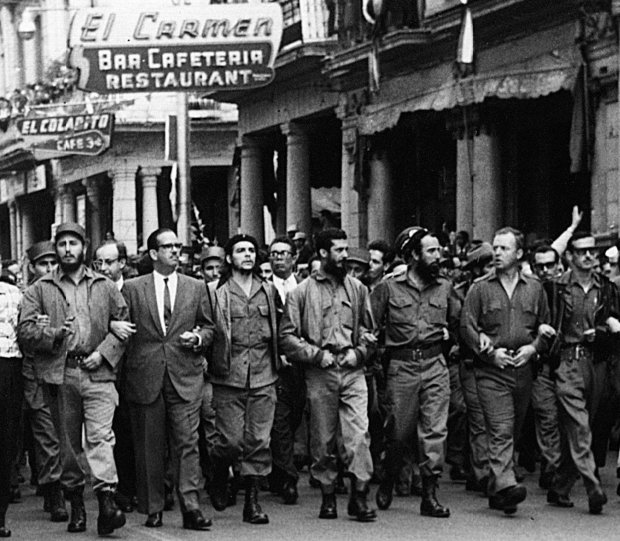
So, you had to remind yourself that he was a killer. He and his main executioner, Che Guevara, summarily killed thousands of political critics and opponents when they took power.
Turned out those 22 released Americans were not political prisoners at all, but drug dealers. They were scooped up, handcuffed, and led off the plane by waiting FBI agents who had stormed the plane when we returned to Washington.
Cuba Libre!
Veteran political reporter Peter Lucas can be reached at: peter.lucas@bostonherald.com